
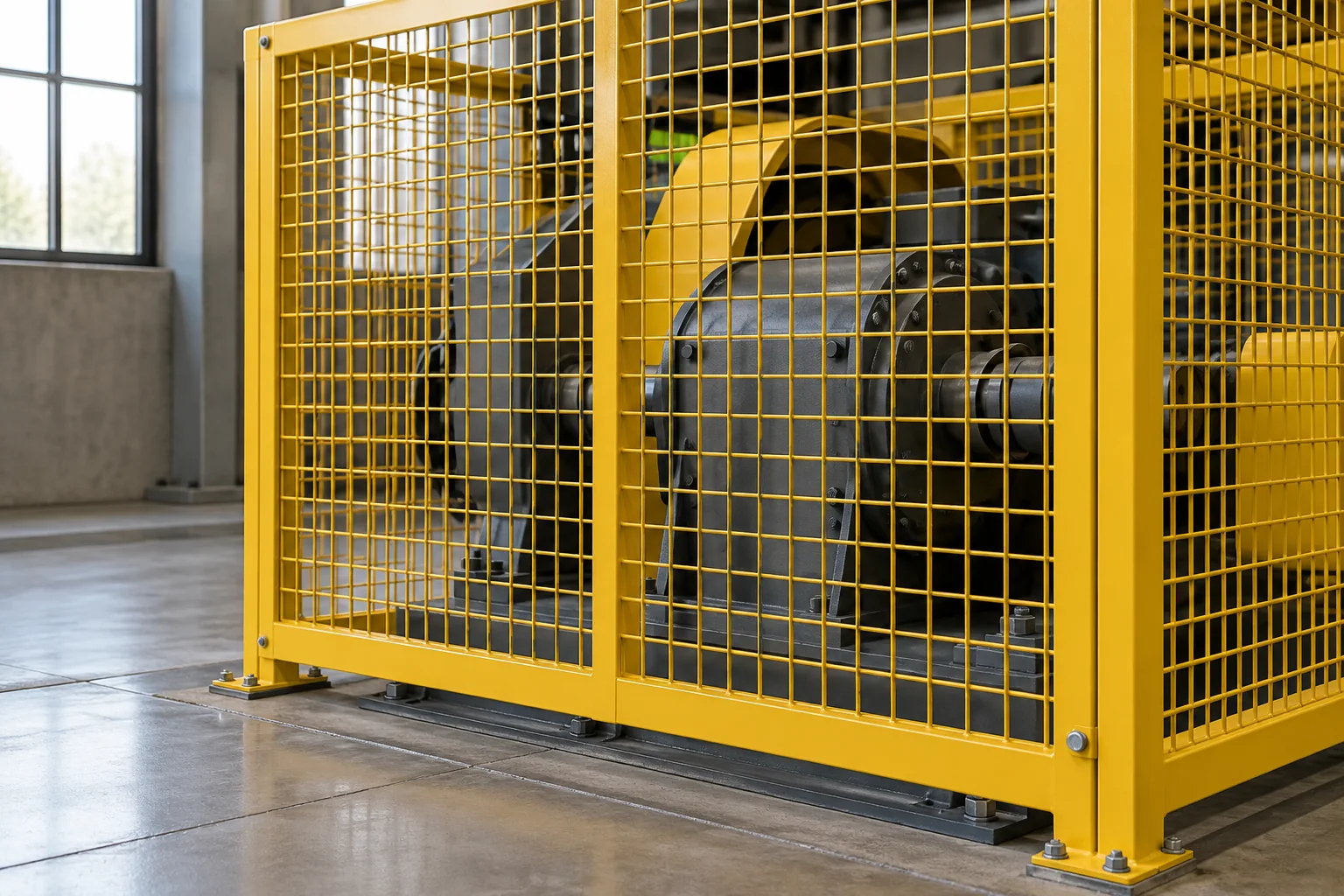
Start with the danger zone and specific operation
Similar-looking casings may perform different functions: restricting access to moving parts, containing ejected fragments or protecting against another hazard. The examination therefore begins by asking which hazard the structure was meant to protect against and during which operation. Different indicators matter for a machine tool, conveyor and installation with stored energy. The statement “protection was absent” is too general without identifying the zone and operating mode.
The specialist establishes the machine model and variant, line composition, workplace arrangement and intended access methods. Normal operation, setting up, cleaning and maintenance are considered separately: information about one mode cannot automatically be extended to another. A site diagram links each guard to a particular mechanism and helps check that the specific path of possible exposure raised in the question was examined.
Assess the guard together with the safety circuit
A door and a sensor mounted on it do not show how the entire system operates. The examination distinguishes the mechanical barrier, position-monitoring device, signal processing and the actuating part that stops hazardous movement. If the design keeps the door locked until the hazard has ceased, that is another distinct function. Checking one sensor does not automatically substantiate the serviceability of other elements.
The technical passport, manual and diagrams are compared with the actual equipment configuration. Component markings, mounting points, clearances, deformation, available repair traces and recorded configuration changes matter. A normal stop button or emergency stop switch cannot be treated as equivalent to a guard without justification. Their purpose and role are established from the design of the particular machine, operating conditions and relevant documentation.
Condition after repair does not itself describe the past
In an incident dispute, three dates must be distinguished: the event, initial recording and later inspection. Between them, a safety switch may have been replaced, a fastening restored or control software updated. A new element's serviceability substantiates its condition when checked but does not prove that the removed device was serviceable. The reverse error is explaining a past event by damage first discovered much later.
Earlier condition is reconstructed using initial photographs, available signal and fault records, maintenance reports, information about replaced parts and preserved components. Each source is linked to a specific machine and time. The absence of a fault message is assessed in light of which events the system recorded at all and whether the complete log survives. A silent recorder does not equal substantiated serviceability of the protection.
The scope of checking depends on safe access
Some questions can be resolved through document comparison and inspection without operating the machine. Functional checks are possible only under agreed safe arrangements, involving specialists responsible for the equipment and documenting conditions. An examination does not require demonstrating dangerous contact, a person entering a working zone or disabling protection for clarity. Access limits are recorded in the results.
If the stopping sequence matters to the answer, relevant technical data or permissible measurements under an appropriate method are needed. The time an indicator disappears from a panel and the time hazardous movement stops may describe different events. Mode, load and component condition affect the result, so one observation cannot be extended to every operating condition without explanation.
- State which elements are available for direct examination and which are known only from documents.
- Record the configuration and conditions of every permissible check.
- Explain which questions remain unresolved without additional data.
Link the finding to the function checked
A useful result shows which safety function is intended, what was established about its condition and which observations support the answer. A finding that a defect exists is separately compared with the incident mechanism: could the defect affect the path of exposure considered, and at what point? A design nonconformity alone does not establish the entire event sequence or participants' liability.
If the original configuration is lost, a supported outcome may be a limited answer about available indicators and missing information. Such an examination does not authorise operation and does not replace a special assessment of working conditions (SOUT), an industrial safety expert examination or the work of an accident investigation commission. Its subject is the agreed technical questions about specific equipment and a defined period.